The process of decentralization is designated as one of the priorities of the current Ukraine’s authorities who aim to vest powers, resources, and responsibilities in local self-government bodies by transferring them from the executive branch. The country’s regional diversity implies the involvement of the minority factor as one of the key factors of decentralization policies, particularly in the poly-ethnic regions of Chernivtsi, Odessa and Transcarpathia. In his comment for the ICELDS Dr. Taras Khalavka, expert in ethnic relations, provides his vision of the decentralization policies on the example of the region of Chernivtsi.
Taras Khalavka: Ukraine inherited a rather centralized governance system from the Soviet regime. The authorities of villages and small towns have neither resources, nor authority to manage educational, medical or cultural spheres. At the district level the power belonged to executive bodies (administrations). The impact of the local self-government bodies on these processes was limited.
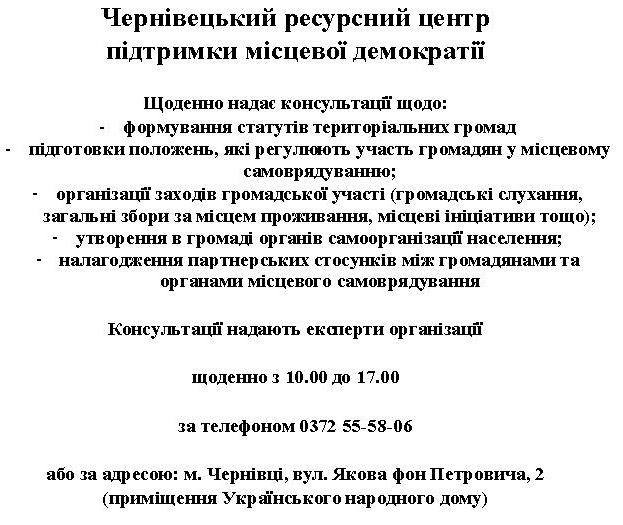
The process of decentralization started in Ukraine in 2015. It foresees the transfer of powers from the executive bodies at the district level to the administrative units of the basic level – the amalgamated territorial communities (ATCs). The ATCs are formed on a voluntary basis as an association of several settlements (towns, villages, townships) pursuant to the Law on Voluntary Amalgamation of Territorial Communities and the Methodology approved by the Government. This process is absolutely voluntary. In fact, there are ATCs formed as an association of just two settlements (the smallest community in the region of Chernivtsi has 2,500 people). There are also large communities of up to 40,000 persons which include ten or even more settlements. The ATCs receive significant financial resources, as well as powers to manage the spheres of education and culture. The process of the ATC formation in the poly-ethnic regions, where various national minorities reside, is very interesting. There are three districts in the region of Chernivtsi where Romanians compactly reside, and one where Moldovans live. The communities with a mixed ethnic composition are being formed in these regions.
According to the Law on Voluntary Amalgamation of Territorial Communities, “when deciding on the voluntary amalgamation of territorial communities, historical, natural, ethnic, cultural and other factors which affect social and economic development of the amalgamated territorial community shall be taken into account.” The criteria included in the Methodology for the formation of ATCs are the historical, geographical, social, economic, and cultural features of the development of a specific territorial unit.
The Ukrainian legislation establishes no further specific criteria for the ATC formation in the areas of compact residence of national or linguistic minorities. A more precise regulation of the national minorities’ needs will be required in case of transformation from a voluntary to an administrative association.
As mentioned before, the process of the ATC formation is currently voluntary. The local authorities (the council and the chairman) independently decide on the merger with the neighbors. The Methodology for the Formation of Capable Territorial Communities also foresees public discussions which implies the involvement of the residents of the communities in question. Therefore, the voluntary nature of the decentralization process implies various configurations of the ATCs:
The ATCs with a mono-ethnic population (Ukrainians or Romanians). The representatives of national minorities compactly reside in the following amalgamated territorial communities: Chudei, Krasnoilsk, Terebleche, Ostrytsia, and Mamalyha (there is only one village with the Ukrainian majority out of six settlements which formed this community);
The ATCs with a multiethnic population. In some cases members of the country’s titular nation form a minority (Mahala, Voloka), while in other cases Ukrainians constitute majority (Vashkivtsi).
Ukrainians compactly reside in other amalgamated territorial communities.
Powers in the spheres of culture and education are being transferred to the authorities of the amalgamated communities that give them the opportunity to form independently their cultural and educational agendas, including those in the minority languages. However, the new ATCs often lack specialists who could provide professional methodological work in the sphere of education. Small ATCs are financially limited in organizing their cultural events (festivals, competitions, etc.). Previously these events were held at the district level; now they were transferred to the ATC level. Consolidation of the capacities of several ATCs could be one of the possible solutions, as is stipulated by the Law on Cooperation of Territorial Communities. However, the ATCs have not used this opportunity in practice.
Thus, I believe that the most urgent issues of research pertinent to the role of minorities in the process of decentralization are the following:
formation of models of multi-ethnic communities and consideration of the needs of national minorities in this process. This issue will be actualized during the transition process to the administrative formation of the ATC;
Legislation on local elections. Elections in the rural ATCs (with villages as the community centers) are held on a majority basis, while in the urban ATCs (with cities/towns as the community centers) the proportional representation system applies. It is important to determine the possibilities for participation of representatives of national minorities in the electoral process, especially in the case of proportion elections;
Application of the provisions of the Law on Cooperation of Territorial Communities in the context of realization of the rights of the persons belonging to national minorities in the ATCs;
Use of minority languages and the state language in the ethnically mixed ATCs;
Formation of the hub-schools in the poly-ethnic regions.
This list is not exhaustive and can therefore be extended. Читати далі: Decentralization in Ukraine: an Opportunity for National Minorities?
This report was prepared by the team of the European Centre for Minority Issues (Flensburg, Germany) with participation of experts from Belarus, Moldova and Ukraine. The listed authors do not necessarily agree to all the contents and conclusions of the report.
Contributors: Carolina Bagrin (Moldova), Olga Gonchearova (Moldova), Ion Duminika (Moldova), Taras Khalavka (Ukraine), Maksim Karaliov (Belarus), Natalya Mekahal (Ukraine), Aleksandr Nayman (Ukraine), Alexander Osipov (Germany), Tatiana Pylypchuk (Ukraine), Tatiana Rybak (Moldova), Andrey Tikhomirov (Belarus), Hanna Vasilevich (Germany), Olga Vasilyeva (Ukraine), Ales Yevseyenko (Belarus), Roman Yurgel (Belarus).
According to Article 9 of the Constitution of Ukraine of 1996 “international treaties that are in force, agreed to be binding by the Verkhovna Rada [Parliament] of Ukraine, are part of the national legislation of Ukraine”. Ukraine participates on all main universal and European international instruments on human rights, including the International Covenant on Civil and Political Rights and the International Convention on the Elimination of All Forms of Racial Discrimination. Ukraine is also a member of other UN conventions on human rights. Ukraine is a party to all main conventions of the Council of Europe on human rights, including ECHR, renewed European Social Charter and FCNM; it has also signed and ratified the European Charter for Regional or Minority Languages. Special chapters regulating provision of the rights of persons belonging to ethnic minorities are present in inter-governmental treaties between Ukraine and its neighbours, namely Poland (1992), Moldova (1996), Romania (1997), Republic of Belarus (1997) and Russia (1997). A separate Agreement on cooperation in ensuring the rights of persons belonging to national minorities was signed with the Republic of Moldova, and is still to be ratified by the Parliament of Moldova.
General Constitutional and Legislative Norms on Equality
The awareness-raising educational cartoon “What are the minority rights?” has three key ambitions: to educate, to promote respect for diversity and its normative framework, and in the longer term, to have an impact on the wider policy level throughout Europe.
The Annual Programme 2017 of the ECMI is now online! The publication contains information on planned activities and initiatives in research and Action for 2017.
What is the ECMI team planning for 2017? What are our Focus Points? How do we plan to promote minority rights throughout the next year? The ECMI Annual Programme 2017 outlines few highlights for the upcoming year, including ongoing research and action oriented projects and the planned initiatives within the ECMI research clusters. ECMI Eastern Partnership Programme (EPP), the ECMI involvement in Western Balkans, offices in Kosovo and Caucasus, research initiatives at headquarters in Flensburg, training activities and newly launched Erasmus+ project on “Teaching in Diversity” are among some of the milestones.
Traditionally, the ECMI Director Prof. Dr. Tove Malloy welcomes the readers in a foreword: “Welcome to our Annual Programme 2017. The European Centre for Minority Issues (ECMI) is entering its third decade of work with a number of new skills and enhanced knowledge acquired to meet the demands of the ever-changing landscape of minority issues and protection in Europe. The rise of populism in a number of countries across Europe requires us to focus more on democratic education and awareness raising as well as media ethics, while the processes of EU association and in/direct conditionality calls for institution building in transition countries. Through knowledge transfer, we will continue to disseminate good practice examples and teach the European legal framework on minority protection. Eastern Europe will be our main focus again in 2017 with intensified activities in Ukraine. We have also returned to the Western Balkans with a special focus on social rights, and this initiative will be developed further in 2017. As always, we welcome dialogue with our partners and look forward to cooperating with you.” Download the ECMI Annual Programme 2017 Access the ECMI Publications DatabaseЧитати далі: Online now: ECMI Annual Programme 2017
What are the executive bodies responsible for minority policy? How do they function? These are the main topics of the current EPP seminars taking place on 12-14 December 2016 in Kyiv, Ukraine.
The EPP seminar on functions and competences of bodies of executive power responsible for minority policy has started yesterday in Kyiv. Dr. Alexander Osipov, the ECMI Senior Research Associate and Academic Director of the ECMI Eastern Partnership Programme (EPP) talked about the main concepts and definitions related to minority issues, along with the main problems and questions connected to the statistics in this field. Today Danish Ambassador in Ukraine Mr. Christian Dons Christensen gave welcoming speech.
The seminar is organized in cooperation with the Office of the Ukrainian Parliament Commissioner for Human Rights and the Ukrainian Ministry of Culture and will host lectures by international experts as well as presentations by representatives from the Ukrainian Ministry of Culture and the Office of the Ukrainian Parliament Commissioner for Human Rights.
Dr. Detlev Rein will give a presentation on systems of cooperation between a state and national minorities, focusing on the case of Germany. Dr. Rein is an independent researcher in the field of minority protection and current (2016 to 2020) member of the Advisory Committee on the Framework Convention for the Protection of National Minorities. He had been a member of CAHROM and MGS-ROM, member, Chair (2005-2006), and Vice-Chair of DH-MIN (all CoE), Head of the German National Contact Point for the Implementation of National Roma Strategies (EU), and deputy member of the Board of the European Centre for Minority Issues (Flensburg) (2000-2014).
Dr. Petar Teofilović will give a presentation on national minorities and the experience of Serbia. Dr. Petar Teofilović is an Associate Professor for Human Rights Protection, Constitutional, Criminal and Administrative Law at the University of Novi Sad. From 2001 to 2003, he served as senior advisor at the Provincial Secretariat for National Minorities in Vojvodina. In 2003, he was appointed Provincial Ombudsman, becoming the first ombudsman in Serbia. For his contribution to human rights protection, Dr. Teofilović received the honor of being selected as Person of the Year in Serbia by the OSCE in 2006, and he was awarded the Konstantin Obradović prize by the Belgrade Center for Human Rights in 2007.
Follow the ECMI Eastern Partnership page or the EPP Facebook page for further updated from the project. Читати далі: EPP team is in Ukraine: functions and competences of executive bodies responsible for minority policy
During the past several decades, and especially at present, throughout Europe the traditional nation-state has been challenged by rapidly increasing ethnic diversity. European countries have increasingly become less homogeneous and more pluralistic. The past few years have seen the arrival of millions of refugees and economic migrants, a trend that continues today. This special issue will focus on the impact and implications of this most recent influx on the possible (re)definition of “minority rights”.
Relating to this general theme, the following specific topics could be addressed: Differential state recognition of “minority rights” for different types of ethnic/linguistic/cultural minorities:
Are state policies to be directed differently toward traditional “national minorities” and “indigenous minorities”, longer-settled ethnic groups lacking a territorial base (including “metropolitan minorities” having a former or extant colonial origin), diaspora minorities (such as Roma, who may or may not be considered a “national minority”), new migrants and refugees from “non-traditional” origins, etc.? The possible effect of the “new migration” on attitudes and changing state policies toward “national minorities”:
Are state policies toward “national minorities” changing? Are they likely to be affected by nationalistic recriminations stimulated by the “new migration”, adding to the ethnic complexity within traditional nation-states? Whether new refugees and economic migrants may be entitled to the same special rights as longer-established minorities, including both regional minority populations and older ethnic minority populations concentrated within urban areas:
Given the increasing complexity of defining ethnic minorities within European countries (ranging from ethnic groups/nationalities claiming a traditional homeland to the current influx of new migrants – both economic migrants and refugees), how does or should state policy differentially recognize minority rights? The policy implications of the “new migration” serving to reinforce long-existing urban ethnic concentrations in certain neighbourhoods, and possibly to develop new concentrations:
The historic “national minorities” emphasize preservation of their traditional territories, languages and cultures as a basic right, whereas new migrants are subjected more to a policy of integration than cultural maintenance or geographical concentration (although certain concessions may be made, at various levels of government, to longer-settled primarily urban minorities for at least some education, services, etc. in their traditional languages). Recognition of “minority rights” within traditional or re-established nation-states compared to states built on the basis of ethnic pluralism in Europe:
Most countries in Europe developed historically as virtual nation-states; moreover some which had formerly been an integral part of ethnic federations based on more than one nationality have more recently become independent nation-states. The concept of the nation-state has implied a significant degree of presumed ethnic homogeneity, with relatively limited national government interest in or appreciation of ethnic pluralism and diversity. Some European countries have varying degrees of political recognition of historic ethnic minorities (often considered as regional or localized populations with varying degrees of self-government or autonomy, yet still within broader nation-states dominated by a particular ethnicity), while relatively few countries could still be considered officially bicultural or multicultural at the national level. Multiculturalism/ethnic pluralism policies in Europe compared to primarily immigrant-origin countries with diverse populations (including indigenous) beyond Europe:
How and why do European national or sub-national/regional policies differ from primarily immigrant-origin countries (such as Canada) which emphasize a broader multiculturalism policy inclusive of all ethnicities?
Submission Guidelines
This special Issue will be guest-edited by Dr. Alan B. Anderson, Professor Emeritus of Sociology, University of Saskatchewan, Canada.
All contributions will undergo a rigorous peer review process, based on initial editor screening and blind review by a minimum of two anonymous referees. Submissions should be prepared in accordance with the Style Guide of the Journal on Ethnopolitics and Minority Issues in Europe. Please send all submissions and inquiries to Tamara Hoch ( hoch@ecmi.de), by 1 February 2017.
–
About the Journal
The Journal on Ethnopolitics and Minority Issues in Europe (JEMIE) is a peer-reviewed electronic journal edited under the auspices of the European Centre for Minority Issues. JEMIE is a multi-disciplinary journal which addresses minority issues across a broad range of studies, such as ethnopolitics, democratization, conflict management, good governance, participation, minority issues and minority rights.
Problem setting
The term «national minority» is widely used in the legislative base of Ukraine as well as in scientific works of a great number of scientists. However, the context of the meaning is quite different in various normative acts and scientific discourses. This fact, in its turn, leads to the absence of a concrete definition of the main object of a state ethno national policy – «national minorities».
Recent research and publications analysis
Recent publications on the subject matter are represented in the research works of the outstanding Ukrainian and foreign scientists: V.Yevtukh, J. Jackson-Preece, F.Capotorti, O. Kartunov, P.Nadolishniy, V.Troschynsky аnd V.Yakubova.
Paper objective
The article has as its goal giving the definitions of the categories comprising the object of «state ethno national policy», namely the concept «national minority» and introducing a new concept «kin minority» into a scientific discourse. There has been carried out the analysis of the modern normative legal base of Ukraine, all-European normative documents and recommendations and interpreting of the term by Ukrainian and foreign researches .
Paper main body
The author has surveyed scientific literature and legislative base in the context of defining the term «national minority». It has been noted that the principle difference in various authors’ points of view lies in the question of including migrant representatives in national minorities. Thus, according to the UN recommendations and J. Jackson-Preece and F.Capotorti’s points of view migrants belong to national minorities. From the other point of view, the Recommendations of the Council of Europe (Recommendation 1255 (1995) on the protection of the rights of national minorities) and law project of the Conception of state ethno policy in Ukraine by M. Jemilev indicate the necessity of maintaining longstanding, firm and lasting ties with that state, as a precondition for receiving a status of a national minority.
The last statement appeals to the author and has been used in elucidating the definitions «kin state» and «kin- minority».
The European Centre for Minority Issues (ECMI) will hold a conference titled “Available Mechanisms for Combating Discrimination and the Protection of National Minorities in the Eastern Borderland of the European Union, and their Effectiveness at the Local Level”. The conference is organized within the framework of the ECMI Eastern Partnership Programme and will be held on 17-18 May 2017 in Kyiv, Ukraine. The organizers invite speakers from Belarus, Moldova and Ukraine to give a brief (up to 10 min) presentation within the thematic framework of the conference.
The ECMI calls for paper proposals on the following topics:
– Experience in monitoring hate speech and ethnic discrimination at the local level; – Combating discrimination and segregation in the school system; – The development of bilingual education and protection of the right to use minority languages in the school system; – Experience in intercultural learning and the development of tolerance at the local level; – Experience in civil campaigns aimed at combating discrimination and the protection of minorities; – Experience in providing legal aid to individuals and non-governmental organizations with regard to discrimination and protection of minorities at the local level; – Experience of cooperation between national minority organizations and human rights NGOs on the issues of non-discrimination and protection of minorities at the local level; – Experience of cooperation between NGOs and governmental bodies and municipal authorities on the issues of non-discrimination and protection of minorities at the local level.
The ECMI invites governmental and municipal officials; members and employees of non-governmental organizations; researchers, teachers and students at MA and PhD level of educational institutions; and all other people concerned with the issues of equality and ethnic diversity from Belarus, Moldova and Ukraine to submit their proposals. Only proposals from people permanently residing in Belarus, Moldova and Ukraine will be considered.
Please send your electronic application in English or Russian to the ECMI staff members Alexander Osipov and Hanna Vasilevich to both emails: osipov@ecmi.de and vasilevich@ecmi.de.
The application must include:
the presentation title,
an abstract (up to 300 words), and
a brief (up to 300 words) biographical note about the author, including the information on education, professional interests, and professional and social activities.
A sample of a biographical note can be found on the website of the ECMI Eastern Partnership Programme – http://ecmi-epp.org/?page_id=21.
The deadline of submission of applications is 10 January 2017.
The ECMI reserves the right to select the applications; only selected applicants will be contacted by the organizers; the selection results will be announced by 1 February 2017.
The invited applicants will be requested to submit their papers by 31 March 2017 in English or Russian; the lengths of a paper shall not exceed 4 pages (Times New Roman; 1.5 line spacing; font size 12).
Organizers will cover travel expenses and accommodation in Kyiv, Ukraine, of the finally approved speakers. Accommodation will be provided only for the dates of the conference. Читати далі: Call for papers: ECMI conference “Available mechanisms for combating discrimination and the protection of national minorities in the eastern borderland of the European Union, and their effectiveness at the local level”.
Abstract. The results of the Romanian Census (November 2011) have been recently published. Scholars and politicians in Europe might be interested in the results, because comparison with the previous Censuses enables to trace the processes of ethno genesis and acculturation of large cross-border minority – Ukrainian community in Romania. The national minority has survived in spite of the powerful assimilation pressure of the host state and the lack of a state support from the kin state.
The authors have analyzed the census of population in Romania starting from the year 1930 and taking the latest census of 2011, in the context of change in demographic size of the Ukrainian population. The census data were connected with changes in ethno-national policy of the Romanian government.
How does the real situation regarding the rights of Ukrainians in political, educational and religious spheres in Romania look like? The authors made an attempt to give satisfactory answers to these and other questions.
The EPP team has returned after conducting a two-day seminar in the capital and two regional events.
The series of seminars dedicated to the combination of different approaches to equality provision and anti-discrimination was held in Kyiv, Mykolaiv and Vinnytsia. The seminars were organized in cooperation with the Ukrainian Parliament Commissioner for Human Rights, the Ministry of Culture, the Mykolaiv Regional State Administration and the Vinnytsia Regional State Administration.
The seminars topic, “The combination of different approaches to equality provisions and anti-discrimination ” sparked a keen interest with the Ukrainian public, and over 120 people attended the EPP seminars in the three cities.
Three invited experts, Mr. Aleksejs Dimitrovs, Dr. Reeta Toivanen, and Ms.Oxana Gumennaia gave lectures at the events, focusing on the ways of effective anti-discrimination and practical utilization of anti-discrimination legislation for minorities‘ protection. During every seminar the expert lecture was followed by a questions and answers session, and a lively discussion involving everyone attending the seminar: representatives of minority communities, NGO activists, state and regional decision-makers. Читати далі: Concluding seminars on the combination of different approaches to equality provision and anti-discrimination.
Сайт функціонує за фінансового сприяння Програми підтримки національно-культурних товариств, етнічних громад Чернівецької області та української діаспори.